The Sower, The Seed, and The Shema
July 2021
Deuteronomy 6:4
Deuteronomy 7:6-8
The parashah portion this week is titled ואתחנן “va'etchanan”... “And I pleaded” ...Moses pleaded with God to enter the promised land. What follows is God's answer to Moses, a resounding "no". Not just “no” but God answered him “Enough! Never speak to Me about this again” Dt 3:23.
Do you know a little bit about prayers that are “unanswered”? I do. Today is the “shloshim”, thirty days since my wife, Linda’s, passing. Moses said to God, “it would be so easy for you to answer this prayer of mine” Dt 3:23 (paraphrased). Moses prayed to enter the land for the better part of forty years. I, and many of you, prayed long and hard for Linda to be healed. Moses did not take “no” very well, in fact, he was bitter. He told the people of Israel that “it’s because of you that I can’t enter the land” Dt. 3:26.
I’m not bitter. Does that make me better than Moses? I wish. It’s taken a piece out of me that won’t be filled and shouldn’t be filled.
The parashah starts with a “no" but then becomes the most remarkable testament to God’s enduring love. Otherwise, it would just be a tragedy of one man's life work, his greatest goal, shattered.
The “Vaetchanan” portion contains a treasure of scriptures: the ten commandments and not one but two cornerstone passages that we recite every week: the v’ahavtah (you shall love the lord with all your heart, soul and strength) AND the Shema, Dt 6:4-6. It ends with what the portion I read, Dt 7: just read - God’s enduring love for us:
Deuteronomy 7:6-9 For you are a holy people to the LORD your God; the LORD your God has chosen you to be a people for His own possession out of all the peoples who are on the face of the earth.
“The LORD did not set His love on you nor choose you because you were more in number than any of the peoples, for you were the fewest of all peoples, but because the LORD loved you and kept the oath which He swore to your forefathers, the LORD brought you out by a mighty hand and redeemed you from the house of slavery, from the hand of Pharaoh king of Egypt. Know therefore that the LORD your God, He is God, the faithful God, who keeps His covenant and His lovingkindness to a thousandth generation with those who love Him and keep His commandments;
And oh by the way Happy Tu b’Av, the15th of the month of Av. It's Jewish valentines day, a day of love and flowers in Israel. You may have noticed the wonderful full moon on Friday nite. Linda passed away under a full moon as well. Thirty days.
Does Yeshua's Sower and the Seed Parable the riddle that solves a mystery encoded in the Shema? Here is a bit of fun or maybe something deeper: there is a riddle coded into the handwriting of the Shema. Here is a picture I took from our Torah scroll.

Notice that the last letter of the first and last words (of the line in the middle) are super-sized. This happens a handful of times in the handwritten Torah script, as do some under-sized letters as well. It’s not a decoration, it’s a scribal requirement. There is a lot of commentary about these “autiot rabot” - “large letters” but no one knows why, but here’s one explanation. If you pop open a mezuzah hanging on your door, you’ll find the same oversized ע and ד. Why?
The first large letter is the ayin: ע in שמע. Sounds like an “a”. But if you misspell it with the other letter that can sound like and “a”, the word would change from
“SHMA ” שמע turns into ... שמא = SHEMah = “maybe”
“Maybe…. Maybe, Israel, the Lord your god is one”
The Seed That Falls in the Rocks
In the parable of the sower, Yeshua says that a sower went out to sow, some of the seed fell among rocks, and it had no roots:
Yeshua explains - “this is the one who hears the Word (a reference to the “Shema*** ”... “HEAR!”, I believe ) but has no roots”. This person, represented by the seed that falls on rocky ground says “MAYBE”... SHEM-ah…שמא… to the word of God. Maybe to God, Maybe not. And falls away.
Other seeds in the parable fall among the thorns:
“this is the one who hears the word with joy, but the worries and cares of this life and the desire for other things choke it out. The last large letter in the last one is the dalet in “echad”. It is easily mistaken for a RESH. dalet ד … resh ר. Similar. But if you make this mistake, the word becomes..
not ECHAD אחד, but ACHAR אחר … meaning something “OTHER אחר”. This person errs and says
“Hear o Israel, the Lord your god is …. ACHAR - (something) OTHER.”
Yeshua said that the seed that falls among the thorns is the person who HEARS - (again, a reference to the Shema) - the world but says… these troubles of life, the worries of this world and the desire for OTHER … ACHAR… thing chokes out faith. ACHAR … not ECHAD… make me look elsewhere, not to God, for my answers.
Yeshua’s parable ends with the seed that falls on the good soil. This is “the one who hears … SHMA … the word and it bears fruit, 30, 60, one hundred fold.”
כי מאהבת יהוה אתכם “it is because of God’s Love for you” Dt 7:8.
Moses pleaded with God for a result. What he received was the Love of God. And that, on this Tu b’Av, the 15th of Av, a festival of love is what the godly man, the godly woman would want the most.
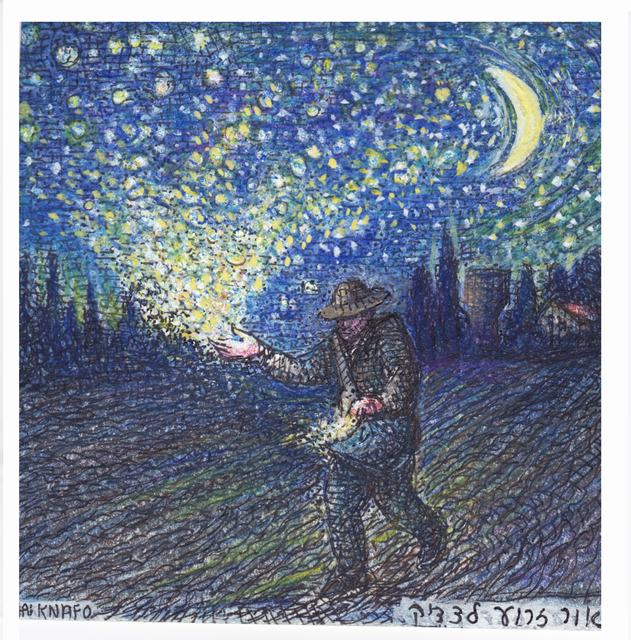
“Starlight Sower”, painting by the artist Hai Knafo who was inspired by Or Zaruaa Synagogue in Jerusalem 2011 ( "Light is sown for the righteous" Psalms, chapter 97 verse 11.)
עברית: ציור של הצייר חי כנפו "אר זרוע לצדיק" ובהשראת שם בית הכנסת אור זרוע לעדת המערביים בירושלים
This file is made available under the Creative Commons CC0 1.0 Universal Public Domain Dedication
*** The word in the prayer called the “Shema” is pronounced “shma”. But in English, we call it the “Shema”. So that’s how I’ve written it

Comments
Post a Comment